Dr. Phyto
Phytophthora root + crown rot
Phytophthora cinnamomi
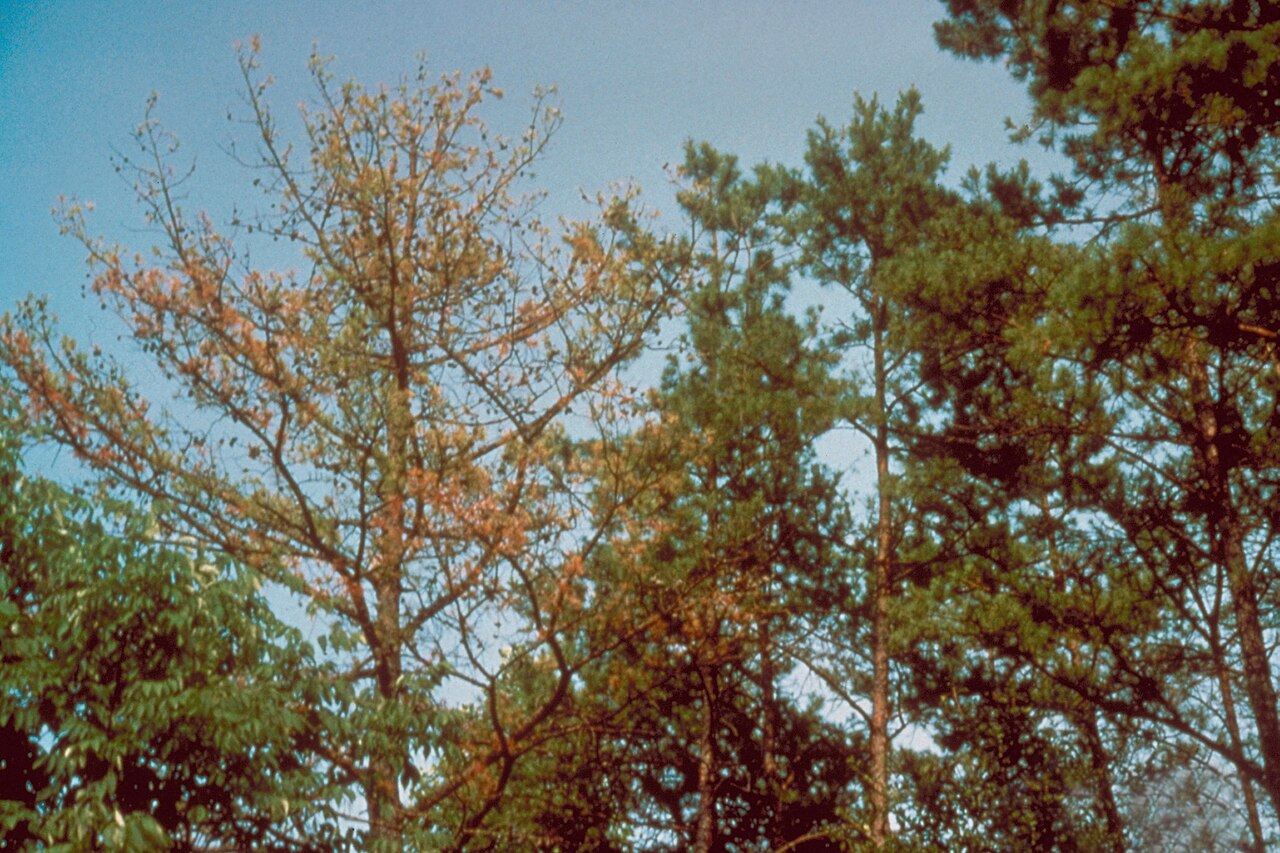
Symptoms
Sudden wilting + collapse of mature trees during summer heat stress, dark sunken cankers at base of trunk often oozing dark sap, root system rotted away to small white feeder roots only, gradual general decline + sparse foliage 1-3 years before final collapse, characteristic V-shaped soil-line lesion when bark peeled back.
Plants affected
Easily confused with
- white root rot
How to tell them apart: Phytophthora cinnamomi (avocado root rot) and Rosellinia necatrix (white root rot) both cause the same above-ground decline on avocado, so you must dig at the collar and feeder roots to tell them apart. With P. cinnamomi the fine feeder roots are blackened, brittle and rotten with no white growth; the soil is usually wet or poorly drained and decline spreads slowly through the tree. With R. necatrix you find a dense white-to-greyish fan of mycelium spreading flat under the bark of larger roots and the crown, and white cottony strands in the surrounding soil; affected bark peels to reveal this felt-like white sheet. Look for the white fan and bark felt for Rosellinia versus bare, black, mushy feeder roots in wet soil for Phytophthora.
- honey fungus (Armillaria root rot)
How to tell them apart: Armillaria mellea (honey fungus): peel back the bark at the base of the trunk and roots — you find flat, fan-shaped sheets of creamy-white to cream mycelium with a fresh mushroom smell, plus black, bootlace-like rhizomorphs running through the soil and over the roots. In autumn, clumps of honey-coloured toadstools with a ring on the stem appear at the collar. Decay is moist and stringy. Phytophthora cinnamomi (root and collar rot): the bark at the collar shows dark, sunken lesions and reddish-brown to black staining of the inner bark, often with a dark, sometimes resin- or sap-bleeding margin where dead tissue meets healthy wood. There are no white fans, no rhizomorphs and no toadstools; fine roots are blackened and rotted, and decline is worst on wet, poorly drained or waterlogged soils.
- bronze birch borer
How to tell them apart: Both make a silver birch (Betula pendula) die slowly from the top down — thinning crown, dead twigs and branches, and small, sparse, pale-yellow leaves — because each one chokes the tree's water-and-sap supply. To tell them apart, look at the trunk and main branches. Bronze birch borer (Agrilus anxius) leaves tiny D-shaped exit holes, raised winding ridges (snake-like swellings) over the larval tunnels under the bark, and rusty/coppery callus bumps where the tree tries to heal; dieback usually starts in the upper crown and the underside of the bark shows brown zig-zag galleries. Phytophthora cinnamomi instead attacks the roots and base: look for dark, sunken bleeding cankers at the collar and lower trunk, often with a tarry or rusty ooze, plus soft rotted roots; there are no exit holes and no galleries, and the decline is linked to wet, poorly drained or recently flooded soil. Agrilus anxius is an EU-quarantine organism — if you see D-shaped holes or serpentine galleries on birch in the EU, report it to your national plant protection organisation (NPPO) immediately.
- fire blight
How to tell them apart: Erwinia amylovora (fire blight) attacks Cotoneaster from the TOP DOWN: it enters through blossoms and shoot tips, so the youngest growth wilts first. Affected shoots bend over into a characteristic 'shepherd's crook' and turn dark brown to black, looking scorched as if burned by fire. In warm, humid weather, sticky amber-to-milky bacterial ooze beads on the blackened bark and a sharp margin (canker) separates dead from living wood. The root system and lower trunk stay healthy. Phytophthora cinnamomi (root and collar rot) attacks from the BOTTOM UP: it rots fine roots and the root collar in wet, poorly drained soil, so the whole plant wilts and yellows or browns more or less uniformly despite no shoot-tip hooks and no ooze. Cut the bark at the soil line and you find a reddish-brown to chocolate-coloured dead lesion at the collar, often with a sour smell; the canopy declines steadily rather than showing blackened, fire-scorched young tips. IMPORTANT: Erwinia amylovora is an EU-regulated notifiable quarantine organism. If you see the shepherd's-crook, blackened scorched tips and bacterial ooze, do not prune or move material — report a suspected case to your national plant protection organisation (NPPO) immediately.
- citrus longhorned beetle
How to tell them apart: Anoplophora chinensis (citrus longhorn beetle) is an insect borer: look at the root collar and lower 50 cm of trunk for round-to-oval exit holes 6-11 mm across, T- or slit-shaped egg scars on the bark, and conspicuous piles of pale, coarse sawdust-like frass heaped at the base and over exposed roots; sap may ooze from the round galleries. The damage is mechanical and the wood under the bark is tunnelled by large cream larvae. Phytophthora cinnamomi (root and crown rot) leaves the bark intact with no holes or frass: instead the lower trunk shows dark, water-soaked, sunken bleeding cankers that ooze rusty-black or reddish sap-stain down the bark, and peeling back the bark reveals a sharp tongue-shaped brown necrosis of the inner bark and cambium with a clear margin against healthy cream tissue. Phytophthora is favoured by wet, poorly drained or compacted soil and the fine roots are blackened and rotted, whereas the beetle leaves clean tunnels and ejected frass.
- bacterial blight / canker (multi-host)
How to tell them apart: On Photinia × fraseri, Phytophthora cinnamomi is a soilborne root and crown rot: the trouble starts below ground, so look for whole-branch or whole-plant wilting and dull-brown foliar collapse, sparse roots, and dark reddish-brown cambial staining when you cut the bark at the trunk base near the soil line; decline is worst in waterlogged, poorly drained soil. Pseudomonas syringae pv. syringae is an aerial bacterial disease: look up in the canopy for discrete angular reddish-purple to brown leaf spots, blackened sunken twig and shoot lesions, and cankers that girdle individual shoots from the tip downward, typically after cool wet spring weather or frost. Rule of thumb: Phytophthora kills from the roots up with collar staining, while Pseudomonas kills from the shoot tips down with distinct spots and twig cankers.
- vine weevil
How to tell them apart: Phytophthora cinnamomi is a soil-borne water mould causing root and crown rot: lift a wilting Rhododendron and the fine roots are blackened, soft and slimy, and scraping the bark at the base reveals a reddish-brown to chocolate stain in the inner wood, often after wet, poorly drained or warm soil. Otiorhynchus sulcatus (black vine weevil) damage is mechanical: the rootball holds fat, legless, white C-shaped grubs with pale-brown heads that have gnawed the roots and girdled the crown, while the dull-black flightless adults notch the leaf margins into clean semicircular bites at night. Look for the grubs in the soil and the scalloped leaf edges to confirm the weevil; look for soft black roots and the dark crown stain to confirm Phytophthora.
- kiwifruit bacterial canker (PSA)
How to tell them apart: On kiwifruit, Pseudomonas syringae pv. actinidiae (PSA) attacks above ground: look for rusty red-brown leaf spots ringed by bright yellow halos, dead flower buds, and rust-coloured to milky-white bacterial ooze weeping from cracks in the trunk, leaders and canes — the ooze is heaviest in spring at sap flow and the cankers re-open and run every spring. Phytophthora cinnamomi instead works at or below the soil line: the canker is a dark, sunken, water-soaked patch at the very base of the trunk and crown, and when you peel the bark you find a sharp V-shaped chocolate-brown lesion, while the root system is rotted to slimy stubs with only a few white feeder roots left. Decisive tells: ooze + yellow-haloed leaf spots high in the canopy point to PSA; rotted roots + a soil-line V-lesion with no leaf spots point to Phytophthora.
- sudden oak death / Ramorum blight
How to tell them apart: On Camellia japonica, Phytophthora cinnamomi is a soil-borne root rot: it rots the fine feeder roots (turning them blackish-brown and brittle), produces a reddish-brown V-shaped canker at the soil line/crown, and the canopy slowly yellows, wilts and dies back over 1-3 years while symptoms rise FROM the base upward; the roots are visibly decayed. Phytophthora ramorum is an aerial blight with healthy roots: look for dark brown, water-soaked leaf lesions with a sharp defined margin starting at the leaf tip or petiole and running down the midrib, blackened spreading stem cankers and shoot dieback on the UPPER plant, plus rapid leaf drop a few days after infection. Rule of thumb: damage rising from the soil line with rotten roots = P. cinnamomi; lesions and dieback on leaves and shoots with sound roots = suspected P. ramorum. P. ramorum is an EU-quarantine notifiable organism (Reg. 2019/2072 Annex II), so if the upper-plant pattern fits, do NOT prune or move the plant and report it to your national plant-health authority (NPPO) first.
- drought stress
How to tell them apart: Drought stress and Phytophthora cinnamomi root rot look almost identical in the cedar canopy: both give crown-wide needle yellowing then browning, thinning foliage and progressive branch dieback, often starting in the upper crown. The decisive check is below ground. With drought the soil is genuinely dry, the roots and root collar stay firm, pale and healthy, and the tree recovers after deep watering. With Phytophthora the fine roots are blackened, soft and rotten with a cinnamon-brown discolouration under the bark, there is often a dark, sometimes resin-bleeding lesion at the root collar, and the decline persists or worsens even in moist, poorly drained or over-irrigated soil.
- brown soft scale
How to tell them apart: On holly, both can begin as dull whole-plant yellowing with thin foliage and twig dieback, but the decisive signs sit in different places. Coccus hesperidum (brown soft scale) shows on the ABOVE-GROUND parts: flat oval brown-to-tan scales 3-5mm clamped onto leaf undersides and along stems, a sticky shiny honeydew film on lower leaves, black sooty mould growing on that honeydew, and ants running on the plant. Phytophthora cinnamomi (Phytophthora root and crown rot) shows NOTHING on the leaves themselves: instead look at the base of the trunk for a dark sunken canker often oozing sap, a brown V-shaped lesion under the bark at the soil line, and roots rotted away to a few white feeder tips. The plant test: scales and sticky leaves that wipe off honeydew = the scale insect; dry leaves with a rotten base and dead roots = the root rot.
Treatment
Dr. Phyto builds a dated, step-by-step treatment plan with country-approved products — start a free diagnosis to get yours.
Common questions
- How do I recognise Phytophthora root + crown rot on avocado?
- Sudden wilting + collapse of mature trees during summer heat stress, dark sunken cankers at base of trunk often oozing dark sap, root system rotted away to small white feeder roots only, gradual general decline + sparse foliage 1-3 years before final collapse, characteristic V-shaped soil-line lesion when bark peeled back.
- Do I have to report Phytophthora root + crown rot?
- No. Phytophthora root + crown rot is not a notifiable organism, so there is nothing to report to an authority. Treat it as a normal garden problem.
- How is Phytophthora root + crown rot treated?
- Mainly with biological and cultural measures — removing affected material, changing the conditions that favour it, and treating with agents approved in your country. The exact steps and their timing depend on the plant, the season and where you live: Dr. Phyto works them out in a free diagnosis.
Free first diagnosis · no sign-up to start