Dr. Phyto
tomato brown rugose fruit virus (ToBRFV)
Tomato brown rugose fruit virus
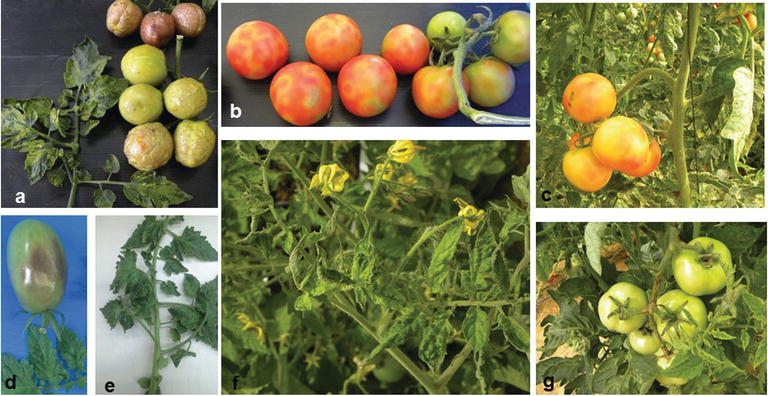
Symptoms
Mosaic and yellowing on young leaves with downward narrow leaflets, brown rugose (wrinkled) spots on ripening fruit, deformed fruit with patchy ripening, yield loss up to 70%.
Plants affected
Easily confused with
- tomato leaf mold
How to tell them apart: Tomato brown rugose fruit virus (ToBRFV) is an EU-established tobamovirus: it produces a true systemic MOSAIC — irregular patches of light and dark green plus yellow mottling spread across the whole upper leaf surface — together with narrowing, blistering and fern-like deformation of new leaves, and tell-tale brown wrinkled (rugose) blotches and yellow spots on the FRUIT. The discolouration is purely a colour pattern with no fungal growth and no spores. Cladosporium fulvum (tomato leaf mold) starts as diffuse pale-green to yellow blotches only on the UPPER surface of older lower leaves, but the decisive sign is on the LOWER surface directly beneath each blotch: an olive-green to greyish-brown VELVETY mould of spores. Leaf mold never deforms new growth and never marks the fruit, and it thrives in humid, poorly ventilated greenhouses. If you see velvety mould under yellow spots it is leaf mold; if you see mottled mosaic with deformed leaves and brown rugose fruit and NO mould, it is ToBRFV — a common, EU-established viral disease managed with the usual hygiene, seed and crop-management measures.
- blossom end rot
How to tell them apart: Tomato brown rugose fruit virus (ToBRFV) produces brown to yellow rugose (wrinkled), marbled or blotchy patches scattered randomly over the whole fruit surface, often with uneven, mottled ripening and necrotic spots; leaves also show mosaic, mottling, narrowing and 'fern-leaf' distortion, and many fruits on the plant are affected at once. Abiotic blossom end rot is a single, sharply defined sunken lesion located only at the blossom (bottom) end of the fruit, starting as a water-soaked spot that turns dark brown to black, dry and leathery; the rest of the fruit ripens normally and foliage stays healthy. The key visible signs: scattered wrinkled mosaic over the whole fruit plus leaf distortion (virus) versus one dry sunken black patch at the bottom tip only (calcium-related disorder). Blossom end rot is worst on the first fruits during heat or irregular watering.
Treatment
Dr. Phyto builds a dated, step-by-step treatment plan with country-approved products — start a free diagnosis to get yours.
Common questions
- How do I recognise tomato brown rugose fruit virus (ToBRFV) on tomato?
- Mosaic and yellowing on young leaves with downward narrow leaflets, brown rugose (wrinkled) spots on ripening fruit, deformed fruit with patchy ripening, yield loss up to 70%.
- Do I have to report tomato brown rugose fruit virus (ToBRFV)?
- No. tomato brown rugose fruit virus (ToBRFV) is not a notifiable organism, so there is nothing to report to an authority. Treat it as a normal garden problem.
- How is tomato brown rugose fruit virus (ToBRFV) treated?
- Mainly with biological and cultural measures — removing affected material, changing the conditions that favour it, and treating with agents approved in your country. The exact steps and their timing depend on the plant, the season and where you live: Dr. Phyto works them out in a free diagnosis.
Free first diagnosis · no sign-up to start