Dr. Phyto
American brown rot of stone fruit
Monilinia fructicola
Symptoms
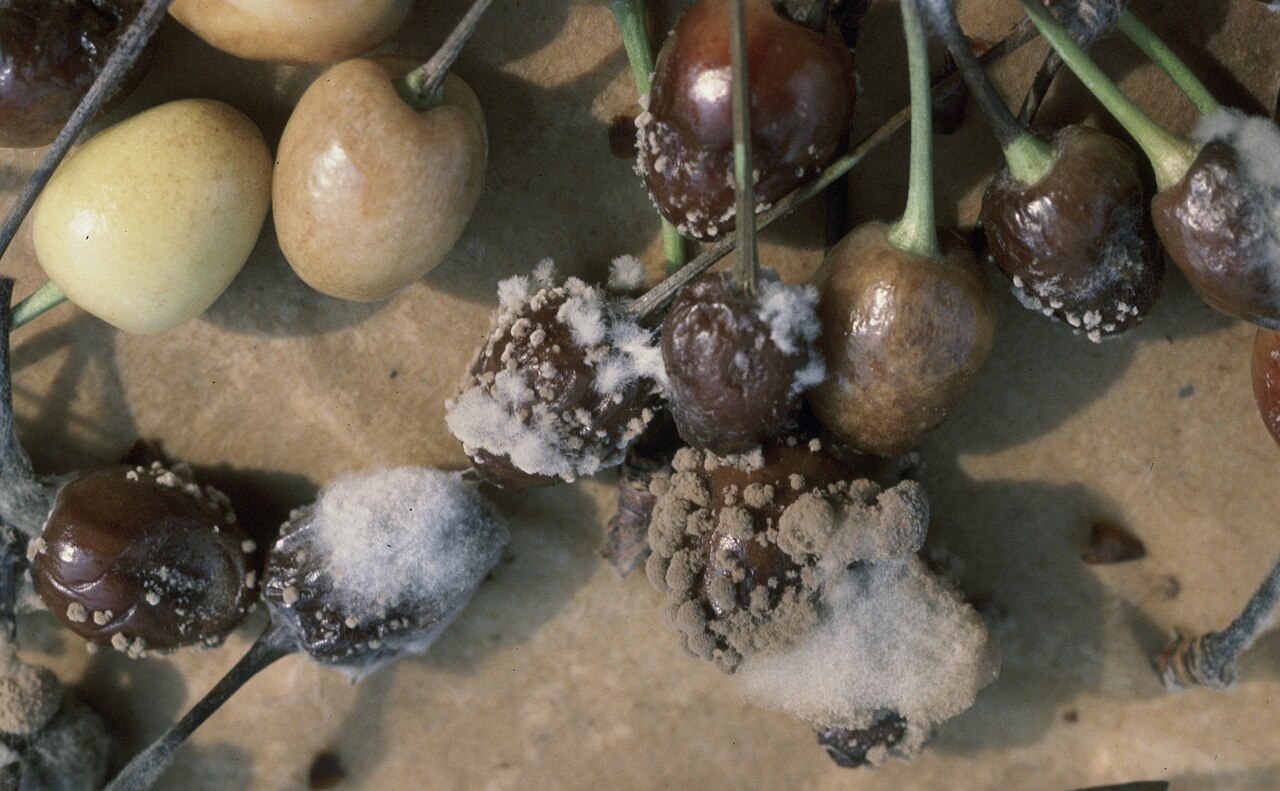
Soft brown rotting patches on ripening + ripe fruit, characteristic tan-colored powdery spore tufts on rot surface, fruit shrivels into hard black mummy and stays attached to twig, blossom blight in spring (entire flower spurs collapsing), gummosis + cankers at base of infected twigs.
Plants affected
Easily confused with
- European brown rot / blossom blight
How to tell them apart: Both cause brown rot. Monilinia laxa: dominant in Europe, mainly blossom and twig blight early in the season, brown collapsed blossoms and cankered shoots. Monilinia fructicola: a more aggressive, fast-spreading species causing rapid fruit rot with concentric rings of grey-buff spore tufts (spore cushions); it is now widely established across southern Europe and is NOT a Union quarantine or notifiable pest (it is only on the EPPO A2 advisory list, not regulated under EU 2019/2072), so no official reporting is required - manage it like any brown rot with sanitation, removal of mummified fruit and cankers, and protectant/curative fungicides.
- apricot brown rot (fructigena)
How to tell them apart: Both fungi cause brown rot of apricot fruit with concentric rings of tan-to-buff cushion-like spore tufts (sporodochia) on the rotting surface, so the fruit symptom alone cannot tell them apart. Common Monilinia fructigena tends to produce buff to ochre-grey sporodochia, usually progresses more slowly, and is most damaging on ripe and wounded fruit late in the season; mummified fruit stay on the tree. The quarantine Monilinia fructicola is typically more aggressive: it causes rapid, expanding fruit rot, abundant fine grey-to-tan spore masses, and blossom blight with gummy cankers and dieback on flowering twigs, often early in the season. Because the visible signs overlap heavily, the two CANNOT be reliably separated in the field — laboratory confirmation (culture morphology or PCR) is required, and a suspected M. fructicola finding is a notifiable quarantine event.
- bacterial spot of stone fruit
How to tell them apart: Xanthomonas arboricola pv. pruni (bacterial spot) on peach fruit shows many small (1-3 mm), dark brown to black, angular and slightly sunken spots, often with cracking, pitting or a tar-like exudate; lesions stay firm, surface-bound and do NOT spread into a soft rot, and the same pinprick spots with yellow halos appear on the leaves. Monilinia fructicola (brown rot) instead starts as one or a few rapidly enlarging soft brown circular rot patches that engulf and collapse the whole fruit within days, and on the rotten surface it grows tan-to-grey powdery sporulating tufts arranged in rings, finally shrivelling the fruit into a hard wrinkled mummy. Key tell: countless tiny firm black cracked dots (+ leaf shot-holes) = bacterial spot; expanding soft brown rot with fuzzy grey-tan spore cushions and mummification = brown rot.
- shothole / coryneum blight of stone fruit
How to tell them apart: On Japanese plum, Monilinia fructicola (brown rot) and Stigmina carpophila (shot-hole) both produce brown twig lesions and small dark fruit spots early in the season. Brown rot spreads from blighted blossoms into the spur and twig, causing sunken cankers with amber gum, and on fruit it forms an expanding soft rot that within days erupts in concentric rings of tan-buff powdery spore cushions; the whole fruit eventually mummifies. Shot-hole instead gives discrete, fixed purple-bordered spots whose centres dry, fall out and leave clean round holes in leaves, while on fruit the spots stay small, firm, scabby and often raised or corky rather than rotting, and twig lesions bear tiny dark pinpoint fungal dots (sporodochia) without gummy collapse. The decisive sign: a soft expanding rot with buff concentric sporulation and mummified fruit is Monilinia; small fixed scabby spots plus true shot-holes in the leaves is Stigmina.
- Sharka (plum pox)
How to tell them apart: On plum (Prunus salicina), Plum Pox Virus marks are flat surface features of the skin: pale-yellow to brownish rings, arcs and diffuse blotches, often with skin pitting/depressions and lumpy fruit deformation, plus reddish staining and gum flecks in the flesh when cut — the fruit stays firm and does not rot, and the same ring pattern also appears on the leaves as chlorotic rings and vein-banding. Monilinia fructicola (brown rot) instead starts as a small firm tan-brown spot that enlarges into a soft, rapidly spreading rot, and within days erupts in concentric tufts of powdery grey-buff spore cushions (sporodochia) that PPV never produces; infected fruit often shrivels into a hard mummy clinging to the twig in humid warm weather. Key tell: rings/deformation on firm, non-rotting fruit AND ringed leaves = virus; expanding soft brown decay with grey-buff fungal cushions = brown rot. Regulatory note: Monilinia fructicola is the EU Annex IIB notifiable Union quarantine organism here — report a suspected case to your national plant protection organisation (NPPO); Plum Pox Virus is the endemic regulated non-quarantine pest (RNQP, Annex IV) and is not NPPO-notifiable.
Treatment
Dr. Phyto builds a dated, step-by-step treatment plan with country-approved products — start a free diagnosis to get yours.
Common questions
- How do I recognise American brown rot of stone fruit on peach?
- Soft brown rotting patches on ripening + ripe fruit, characteristic tan-colored powdery spore tufts on rot surface, fruit shrivels into hard black mummy and stays attached to twig, blossom blight in spring (entire flower spurs collapsing), gummosis + cankers at base of infected twigs.
- Do I have to report American brown rot of stone fruit?
- No. American brown rot of stone fruit is not a notifiable organism, so there is nothing to report to an authority. Treat it as a normal garden problem.
- How is American brown rot of stone fruit treated?
- Mainly with biological and cultural measures — removing affected material, changing the conditions that favour it, and treating with agents approved in your country. The exact steps and their timing depend on the plant, the season and where you live: Dr. Phyto works them out in a free diagnosis.
Free first diagnosis · no sign-up to start