Dr. Phyto
red thread (lawn disease)
Laetisaria fuciformis
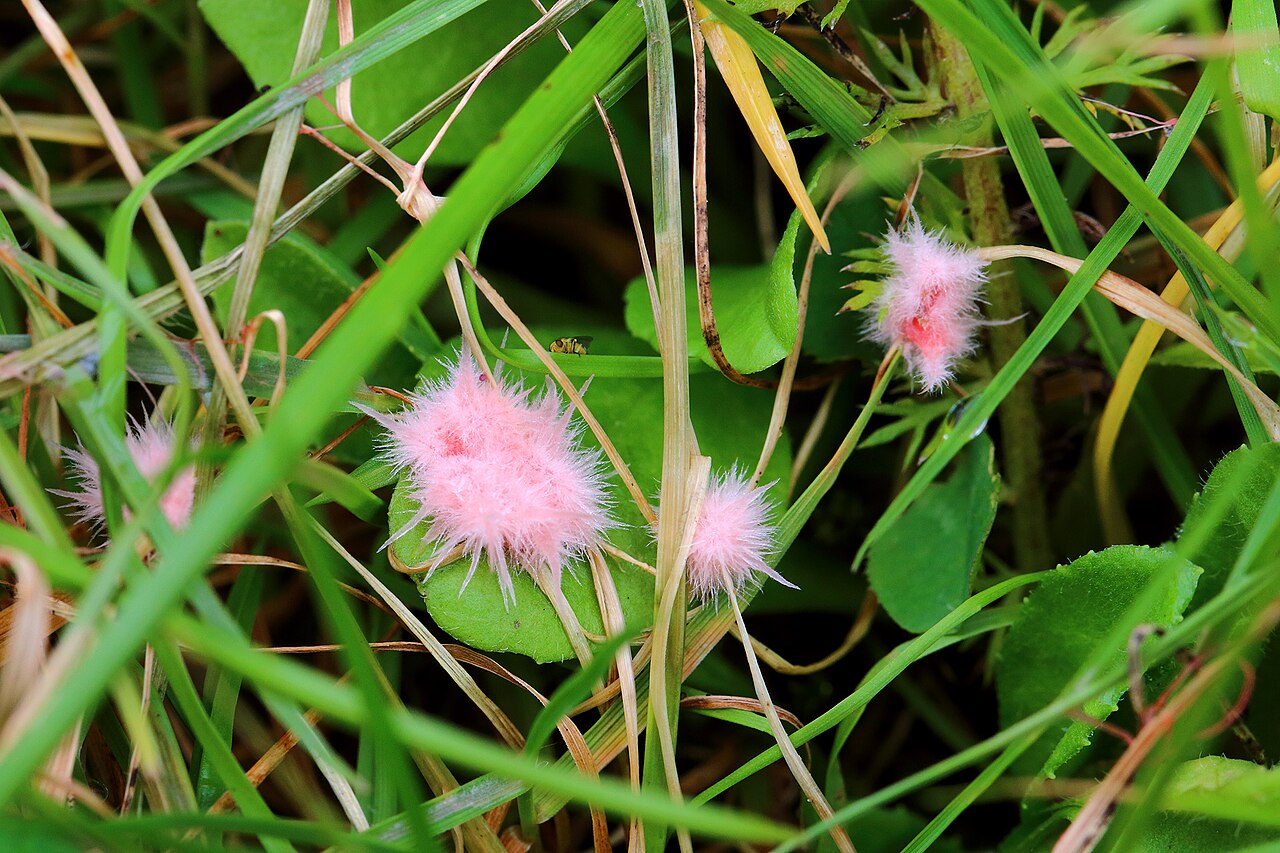
Symptoms
Irregular patches of bleached, straw-pink grass from a few cm to ~25 cm across; close up, tiny coral-pink to red gelatinous threads and branching needles bind the dead leaf tips together — the diagnostic sign; in damp weather a faint pink cotton-wool web may show. Grass is killed only at the leaf, not the root, so the lawn recovers.
Plants affected
Easily confused with
- dollar spot (lawn disease)
How to tell them apart: Clarireedia jacksonii (dollar spot) makes small, sharply defined, sunken straw-coloured circular patches the size of a coin (2-6 cm) that may merge; in early morning dew look for fine white cottony mycelium and, on individual blades, distinctive bleached lesions with a tan centre and reddish-brown margin running across the leaf. Laetisaria fuciformis (red thread) makes larger, more irregular bleached/tan patches and is told apart by its diagnostic coral-pink to red, gelatinous-then-brittle thread-like stromata (antler-like 'red threads') protruding from leaf tips plus pink cottony flocculent mycelium, especially in cool wet weather. If no pink is present, dollar spot shows the hourglass leaf banding while red thread bleaches whole leaf tips uniformly.
- pink snow mould
How to tell them apart: Red Thread (Laetisaria fuciformis) and Microdochium Patch (Microdochium nivale) both bleach perennial ryegrass into tan patches with pink-tinged mycelium, but look closely at leaf tips and patch shape. Laetisaria fuciformis produces unmistakable coral-pink to red, thread-like or antler-like sclerotial strands (stromata) protruding 2-5 mm beyond the dying leaf tips, plus fluffy pink cotton-candy mycelium in irregular, often ragged patches a few centimetres across, typical of cool humid weather on low-nitrogen turf. Microdochium nivale instead makes roughly circular, smooth-edged patches up to 30 cm that turn from water-soaked dark green to tan/straw, with a slimy salmon-pink to white mycelial ring only at the wet margin and NO red threads at the leaf tips, favoured by cold wet conditions or snow cover.
Treatment
Dr. Phyto builds a dated, step-by-step treatment plan with country-approved products — start a free diagnosis to get yours.
Common questions
- How do I recognise red thread (lawn disease) on Creeping bent?
- Irregular patches of bleached, straw-pink grass from a few cm to ~25 cm across; close up, tiny coral-pink to red gelatinous threads and branching needles bind the dead leaf tips together — the diagnostic sign; in damp weather a faint pink cotton-wool web may show. Grass is killed only at the leaf, not the root, so the lawn recovers.
- Do I have to report red thread (lawn disease)?
- No. red thread (lawn disease) is not a notifiable organism, so there is nothing to report to an authority. Treat it as a normal garden problem.
- How is red thread (lawn disease) treated?
- Mainly with biological and cultural measures — removing affected material, changing the conditions that favour it, and treating with agents approved in your country. The exact steps and their timing depend on the plant, the season and where you live: Dr. Phyto works them out in a free diagnosis.
Free first diagnosis · no sign-up to start