Dr. Phyto
barley powdery mildew
Blumeria graminis f.sp. hordei
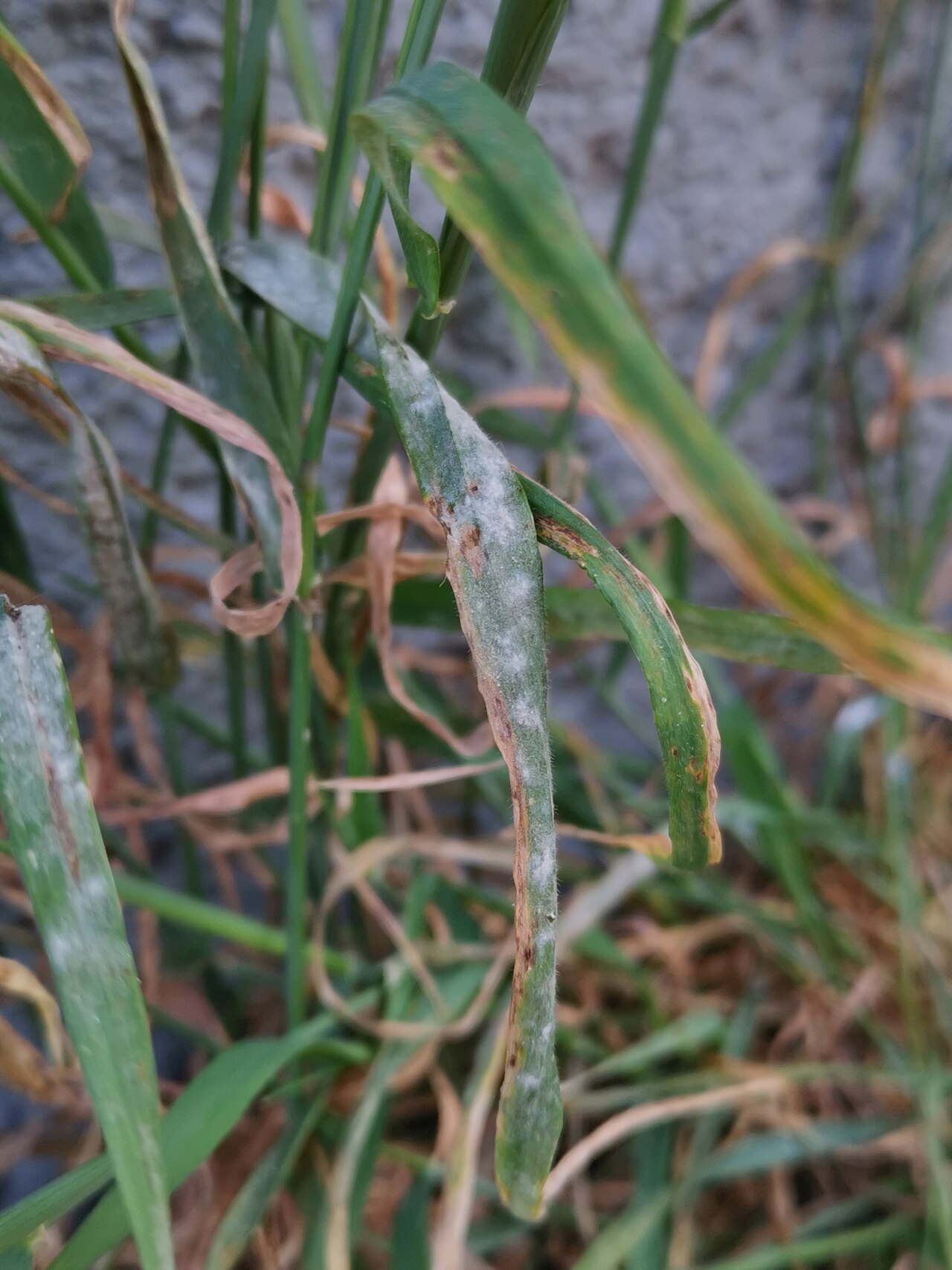
Symptoms
White cottony pustules on upper leaf surfaces of lower canopy, pustules darken to grey-brown with age, infected leaves yellow and senesce 2–3 weeks early.
Plants affected
Easily confused with
- pink snow mould
How to tell them apart: Barley powdery mildew forms superficial, dry, dusty-white to grey pustules that sit ON TOP of the leaf surface, mainly on the upper side of lower leaves and sheaths. The growth is powdery and rubs off easily as a fine flour-like dust, leaving the green leaf tissue beneath. Older colonies turn felted grey-brown with tiny black dots (cleistothecia). It thrives in mild, dry-to-humid weather (15-22 C) without needing free water, and patches stay localised in raised tufts rather than spreading as a flat film. Pink snow mould produces a flat, cottony, web-like mycelial mat that mats DOWN whole leaves and the crown, with a characteristic salmon-pink to pinkish-white tinge, especially at the advancing edge. It is greasy and felted (not dusty) and does not rub off as powder; affected tissue beneath is water-soaked, rotting and bleached. It appears in cold wet conditions, classically after snow melt or in prolonged cool damp spells (0-8 C), forming large coalescing slimy patches over the soil and plant base rather than discrete raised pustules.
Treatment
Dr. Phyto builds a dated, step-by-step treatment plan with country-approved products — start a free diagnosis to get yours.
Common questions
- How do I recognise barley powdery mildew on barley?
- White cottony pustules on upper leaf surfaces of lower canopy, pustules darken to grey-brown with age, infected leaves yellow and senesce 2–3 weeks early.
- Do I have to report barley powdery mildew?
- No. barley powdery mildew is not a notifiable organism, so there is nothing to report to an authority. Treat it as a normal garden problem.
- How is barley powdery mildew treated?
- Mainly with biological and cultural measures — removing affected material, changing the conditions that favour it, and treating with agents approved in your country. The exact steps and their timing depend on the plant, the season and where you live: Dr. Phyto works them out in a free diagnosis.
Free first diagnosis · no sign-up to start