Dr. Phyto
silverleaf whitefly
Bemisia tabaci
Symptoms
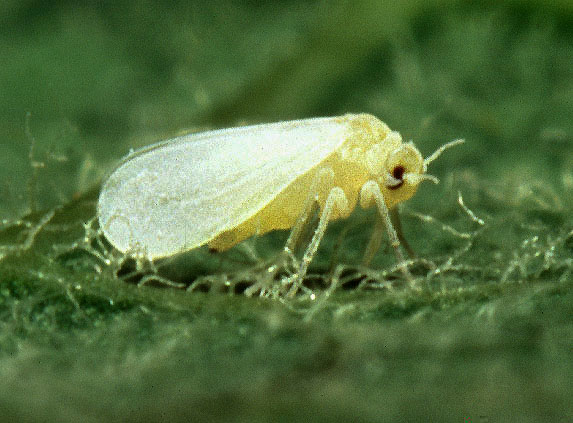
Tiny white moth-like adults flying up from disturbed leaves, sticky honeydew on lower leaves and fruit, sooty mould secondary growth, silvering between veins on cucurbits, irregular ripening on tomato/pepper.
Plants affected
Easily confused with
- cotton aphid
How to tell them apart: Aphis gossypii (cotton/melon aphid): look on stems, growing tips and the underside of leaves for dense, slow-moving colonies of soft, pear-shaped, wingless insects, usually pale yellow to dark blue-green with two small tube-like 'tailpipes' (cornicles) at the rear. They stay put when disturbed, leave white cast skins, and curl leaves downward; ants often patrol the colony. Bemisia tabaci (silverleaf whitefly): look for tiny, 1-2 mm snow-white moth-like insects with wings held roof-like over the body, plus scale-like flat oval nymphs and yellow eggs on the leaf underside. The unmistakable sign is a sudden cloud of white flies that flutters up when you shake the plant, something aphids never do, often with silvering or irregular ripening of melon fruit.
- two-spotted spider mite
How to tell them apart: Bemisia tabaci (tobacco/silverleaf whitefly): look on the leaf underside for tiny (1.5 mm) moth-like flies that hold their wings tent-like over a yellowish body and rise in a small white cloud when the plant is shaken; along the veins you find oval, flat, scale-like translucent nymphs plus sticky honeydew and black sooty mould on lower leaves. Tetranychus urticae (two-spotted spider mite): there are no flying insects at all — only barely-visible 0.5 mm specks (pale green to orange with two dark spots) on the underside, fine pale stippling that becomes a bronze/silvery sandblasted look, and the diagnostic giveaway is fine silk webbing across leaf tips and between stems, worst in hot, dry conditions. Honeydew/sooty mould points to whitefly; webbing and a gritty bronze sheen point to mites.
- Cucumber mosaic virus (CMV)
How to tell them apart: Look on the UNDERSIDE of leaves for tiny (1-2 mm) snow-white moth-like insects that fly up in a cloud when the plant is disturbed, plus clusters of pale scale-like nymphs. Yellowing is diffuse, starts on lower/older leaves, and is accompanied by sticky honeydew and black sooty mould on the leaf surface and fruit. In squash you may also see 'silverleaf' — a silvery sheen on the upper leaf surface. The damage pattern follows where the insects sit, not a sharp leaf-vein mosaic. There are NO insects clustered on the leaf and no honeydew or sooty mould. Look for a sharply contrasted light-and-dark-green MOSAIC or mottle that respects the leaf veins, often with puckering, blistering, downward leaf cupping, narrowed 'shoestring' younger leaves and overall stunting. Fruit may show warty rings or pale-and-dark mottling. The symptom is systemic, appears first on the youngest growth, and cannot be wiped or washed off.
- cucurbit powdery mildew
How to tell them apart: Bemisia tabaci (whitefly) shows tiny moth-like white adults that fly up in a cloud when the leaf is shaken, plus immobile pale-yellow scale-like nymphs stuck to the leaf underside; the white film wipes off and leaves sticky honeydew, and shaded lower leaves often blacken with sooty mould. Podosphaera xanthii (cucurbit powdery mildew) is instead a dry, talc-like white fungal growth that starts as round powdery spots on the UPPER leaf surface and stems, spreads into felty patches that do not fly away, and leaves no honeydew or insects. If nothing flies up and the coating is a dry mat of round spots, it is the mildew; if a white cloud rises and you find scale-like nymphs and sticky residue, it is the whitefly.
- papaya ringspot virus (PRSV)
How to tell them apart: On papaya, Papaya ringspot virus (PRSV) shows systemic leaf mosaic with bright yellow-green mottling, vein-clearing and pronounced 'shoestring' narrowing or blistering of new leaves, plus dark oily ring-spots and streaks on the petioles and upper stem — but there is never any insect, scale or sticky residue present. Bemisia tabaci (tobacco whitefly) instead leaves direct physical evidence: clouds of tiny ~1 mm white moth-like adults fly up when foliage is disturbed, and the LOWER leaf surface bears flat oval yellow-white scales (nymphs); damage is irregular chlorotic stippling and downward leaf curl, with sticky honeydew and black sooty mould coating the leaf tops. The rule of thumb: turn leaves over and tap the canopy — live whiteflies, scales and sticky sooty mould mean Bemisia, whereas clean leaves with mosaic, vein-clearing and ringed oily petiole streaks and no insects point to PRSV. Non-European populations of Bemisia tabaci are an EU quarantine pest (Regulation (EU) 2019/2072 Annex II) — if you find the whitefly, report it to your National Plant Protection Organisation (NPPO); PRSV itself is not an EU-notifiable quarantine organism.
- lantana lace bug
How to tell them apart: On Lantana camara both pests pepper the upper leaf surface with pale yellow stippling and leave dark deposits underneath, but the insects and the deposits differ. Bemisia tabaci (tobacco whitefly) shows tiny soft 1 mm snow-white moth-like adults that rise in a fluttering cloud when the leaf is shaken, plus pale flat oval scales underneath; its deposits are a sticky shiny honeydew sheen that turns into a continuous black sooty-mould film and attracts ants. Teleonemia scrupulosa (lantana lace bug) instead has flat, dark brown to blackish 3-4 mm adults with transparent lace-like sculptured wings held flush on the leaf that do NOT fly off, and its deposits are discrete varnish-like tar-black excrement specks and torpedo-shaped eggs glued to the underside; heavy attack bronzes and browns whole leaves and defoliates the bush rather than leaving a sticky shiny coat. Whitefly = white flying cloud + sticky sooty sheen; lace bug = stationary lacy flat bugs + dry black spots + bronzing.
- geranium rust
How to tell them apart: On geranium (Pelargonium × hortorum) both can start as faint yellow flecks on the upper leaf surface, so always turn the leaf over and tap the plant. Geranium rust (Puccinia pelargonii-zonalis) makes discrete circular yellow spots whose undersides bear raised concentric rings of cinnamon-to-reddish-brown powdery pustules that smear rusty on a finger, and the plant stays still when shaken. Silverleaf whitefly (Bemisia tabaci) instead causes diffuse pale stippling or mottling with sticky shiny honeydew and black sooty mould, and clouds of tiny white moth-like adults plus flat translucent scale-like nymphs sit on the underside and flutter up when disturbed. Powdery brown rings under intact spots = rust; flying white insects, honeydew and sooty mould = whitefly.
Treatment
Dr. Phyto builds a dated, step-by-step treatment plan with country-approved products — start a free diagnosis to get yours.
Common questions
- How do I recognise silverleaf whitefly on melon?
- Tiny white moth-like adults flying up from disturbed leaves, sticky honeydew on lower leaves and fruit, sooty mould secondary growth, silvering between veins on cucurbits, irregular ripening on tomato/pepper.
- Do I have to report silverleaf whitefly?
- No. silverleaf whitefly is not a notifiable organism, so there is nothing to report to an authority. Treat it as a normal garden problem.
- How is silverleaf whitefly treated?
- Mainly with biological and cultural measures — removing affected material, changing the conditions that favour it, and treating with agents approved in your country. The exact steps and their timing depend on the plant, the season and where you live: Dr. Phyto works them out in a free diagnosis.
Free first diagnosis · no sign-up to start