Dr. Phyto
virus de la tache annulaire du papayer
Papaya ringspot virus
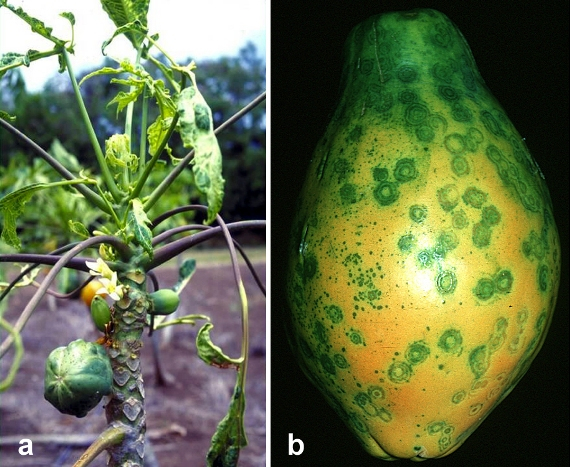
Symptômes
Motifs en mosaïque jaune vif sur les feuilles, feuillage déformé et gaufré, taches annulaires sur les fruits (le symptôme diagnostique et le nom), anneaux concentriques vert foncé à la surface du fruit, rabougrissement sévère et production de fruits réduite, les plants infectés jeunes fructifient rarement.
Plantes touchées
Souvent confondu avec
- anthracnose
Comment les distinguer: Le virus des taches annulaires du papayer (Papaya ringspot virus) présente des anneaux concentriques superficiels, plats à légèrement saillants, et des stries huileuses en forme de C sur la peau verte du fruit, et il s'accompagne toujours de symptômes systémiques ailleurs — mosaïque jaune et cloques sur les jeunes feuilles, feuillage filiforme déformé et stries sombres et huileuses sur les pétioles supérieurs et la tige ; les anneaux ne deviennent jamais déprimés et ne portent jamais de spores. Colletotrichum gloeosporioides (anthracnose) débute au contraire par de petites taches translucides qui s'agrandissent en lésions rondes, nettement DÉPRIMÉES (en creux), en forme de cible avec une zonation concentrique, surtout sur les fruits mûrs ou en cours de maturation, et le centre des lésions développe vite des masses sporales gluantes rose saumon à orange (acervules) par temps humide. Repérez donc : la profondeur (virus plat, champignon en creux), les masses sporales (absentes chez le virus, roses/orange chez l'anthracnose) et le contexte de la plante entière (le virus a toujours une mosaïque foliaire + des stries sur les pétioles ; l'anthracnose reste une pourriture localisée du fruit sans mosaïque foliaire).
- aleurode du tabac
Comment les distinguer: Sur le papayer, le virus des taches annulaires du papayer (PRSV) provoque une mosaïque foliaire systémique avec une marbrure vert-jaune vif, un éclaircissement des nervures et un net rétrécissement 'en lacet' ou un cloquage des jeunes feuilles, ainsi que des taches annulaires et des stries sombres et huileuses sur les pétioles et le haut de la tige — mais sans aucun insecte, écaille ni résidu collant. La Bemisia tabaci (aleurode du tabac) laisse au contraire des preuves physiques directes : en secouant le feuillage, des nuées de minuscules adultes blancs ressemblant à des papillons de ~1 mm s'envolent, et la face INFÉRIEURE des feuilles porte des écailles ovales plates blanc-jaunâtre (larves) ; les dégâts sont une ponctuation chlorotique irrégulière avec enroulement des feuilles vers le bas, du miellat collant et de la fumagine noire sur le dessus des feuilles. Règle pratique : retournez les feuilles et tapotez la frondaison — des aleurodes vivants, des écailles et de la fumagine collante signalent Bemisia, tandis que des feuilles propres avec mosaïque, éclaircissement des nervures et stries huileuses annulaires sur les pétioles sans insectes orientent vers le PRSV. Les populations non européennes de Bemisia tabaci sont un organisme de quarantaine de l'UE (Règlement (UE) 2019/2072 Annexe II) — si vous trouvez l'aleurode, signalez-le à votre Organisation Nationale de Protection des Végétaux (ONPV) ; le PRSV lui-même n'est pas un organisme de quarantaine à notification obligatoire dans l'UE.
Traitement
Dr. Phyto établit un plan de traitement daté, étape par étape, avec des produits homologués dans votre pays — lancez un diagnostic gratuit pour obtenir le vôtre.
Questions fréquentes
- Comment reconnaître virus de la tache annulaire du papayer sur papayer ?
- Motifs en mosaïque jaune vif sur les feuilles, feuillage déformé et gaufré, taches annulaires sur les fruits (le symptôme diagnostique et le nom), anneaux concentriques vert foncé à la surface du fruit, rabougrissement sévère et production de fruits réduite, les plants infectés jeunes fructifient rarement.
- Dois-je déclarer virus de la tache annulaire du papayer ?
- Non. virus de la tache annulaire du papayer n'est pas à déclaration obligatoire : il n'y a rien à signaler à une autorité. Traitez-le comme un problème de jardin ordinaire.
- Comment traite-t-on virus de la tache annulaire du papayer ?
- Surtout par des mesures biologiques et culturales — retirer le matériel atteint, modifier les conditions qui le favorisent et intervenir avec des produits autorisés dans votre pays. Les étapes exactes et leur calendrier dépendent de la plante, de la saison et du lieu : Dr. Phyto les établit lors d'un diagnostic gratuit.
Premier diagnostic gratuit · sans inscription