Dr. Phyto
late blight of celery / Septoria leaf spot
Septoria apiicola
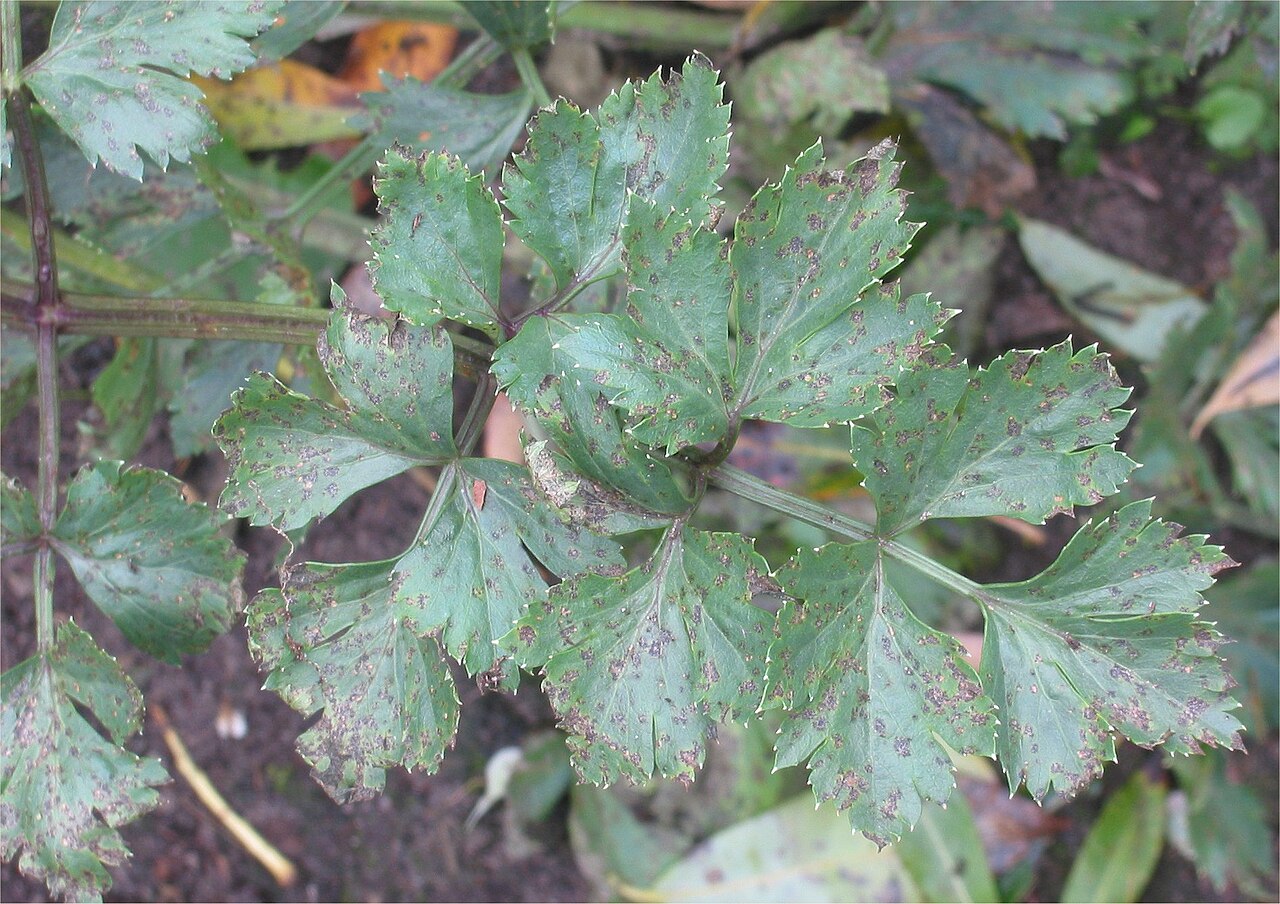
Symptoms
Small (2-5mm) yellow-to-tan leaf spots that progressively turn dark brown, tiny black pycnidia visible inside lesion centers (key diagnostic feature), severe infection causes leaf collapse + stalk lesions, market quality lost when stalks show lesions, plants in dense stands worst affected.
Plants affected
Easily confused with
- early blight of celery / Cercospora leaf spot
How to tell them apart: Both are leaf-spotting fungi of celery foliage and are constantly confused as the paired celery blights. Cercospora apii (early blight) makes pale-yellow spots that enlarge into tan-grey, papery lesions which often tear; in their centres you see a fine GREY, fuzzy, velvety mould (sporulation) but NO embedded dark dots. Septoria apiicola (late blight) makes smaller, irregular yellow-then-brown spots that coalesce, and the giveaway is the scatter of tiny jet-black, round, pinhead-sized PYCNIDIA studded in the centre of each lesion (use a hand lens). Pycnidia present = Septoria; grey fuzz with no black dots = Cercospora.
Treatment
Dr. Phyto builds a dated, step-by-step treatment plan with country-approved products — start a free diagnosis to get yours.
Common questions
- How do I recognise late blight of celery / Septoria leaf spot on celery?
- Small (2-5mm) yellow-to-tan leaf spots that progressively turn dark brown, tiny black pycnidia visible inside lesion centers (key diagnostic feature), severe infection causes leaf collapse + stalk lesions, market quality lost when stalks show lesions, plants in dense stands worst affected.
- Do I have to report late blight of celery / Septoria leaf spot?
- No. late blight of celery / Septoria leaf spot is not a notifiable organism, so there is nothing to report to an authority. Treat it as a normal garden problem.
- How is late blight of celery / Septoria leaf spot treated?
- Mainly with biological and cultural measures — removing affected material, changing the conditions that favour it, and treating with agents approved in your country. The exact steps and their timing depend on the plant, the season and where you live: Dr. Phyto works them out in a free diagnosis.
Free first diagnosis · no sign-up to start