Dr. Phyto
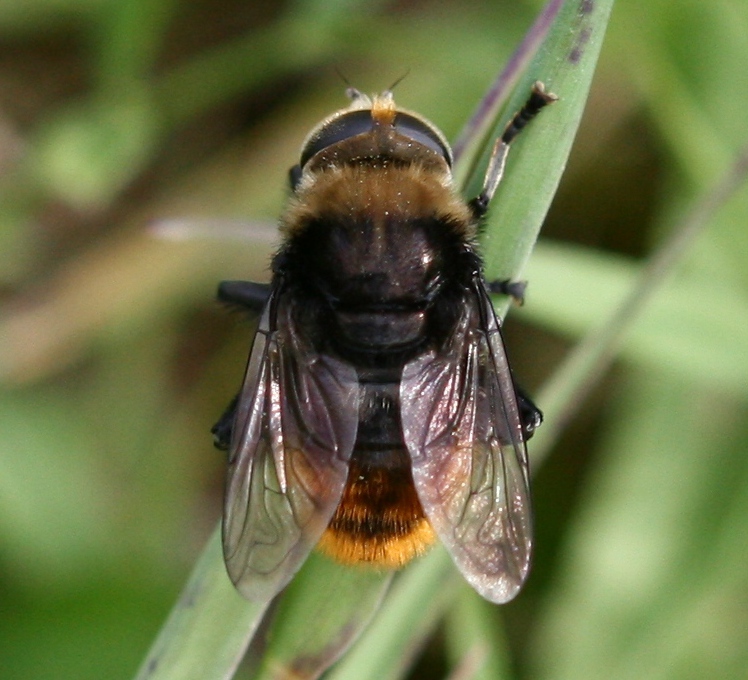
large narcissus bulb fly
Merodon equestris
Symptoms
A single fat, dirty-white maggot (up to ~18 mm) tunnels into and hollows out the centre of the bulb, filling it with brown muddy excrement; attacked bulbs are soft when squeezed, fail to flower or produce only weak grass-like leaves; the adult is a hairy bee-mimic hovering near the foliage in late spring.
Plants affected
Easily confused with
- narcissus basal rot
How to tell them apart: Both wreck a daffodil bulb and give the same above-ground picture — yellow, stunted, twisted, limp foliage and no flowers — so lift and slice the bulb to separate them. Fusarium oxysporum f.sp. narcissi (basal rot) starts at the basal plate as a chocolate-to-reddish-brown dry-firm rot that spreads upward in a sharp brown wedge between the scales, often with pale pink-to-white fungal mould on the base; the bulb feels light and corky. Merodon equestris (large narcissus bulb fly) hollows the bulb out instead: cut it open and you find ONE fat, dirty-cream, legless maggot (up to ~18 mm) sitting in a slimy chamber of soft brown muck and frass, with a single small entry hole near the basal plate where the larva bored in.
Treatment
Dr. Phyto builds a dated, step-by-step treatment plan with country-approved products — start a free diagnosis to get yours.
Common questions
- How do I recognise large narcissus bulb fly on daffodil?
- A single fat, dirty-white maggot (up to ~18 mm) tunnels into and hollows out the centre of the bulb, filling it with brown muddy excrement; attacked bulbs are soft when squeezed, fail to flower or produce only weak grass-like leaves; the adult is a hairy bee-mimic hovering near the foliage in late spring.
- Do I have to report large narcissus bulb fly?
- No. large narcissus bulb fly is not a notifiable organism, so there is nothing to report to an authority. Treat it as a normal garden problem.
- How is large narcissus bulb fly treated?
- Mainly with biological and cultural measures — removing affected material, changing the conditions that favour it, and treating with agents approved in your country. The exact steps and their timing depend on the plant, the season and where you live: Dr. Phyto works them out in a free diagnosis.
Free first diagnosis · no sign-up to start