Dr. Phyto
gummy stem blight / black rot (cucurbits)
Didymella bryoniae
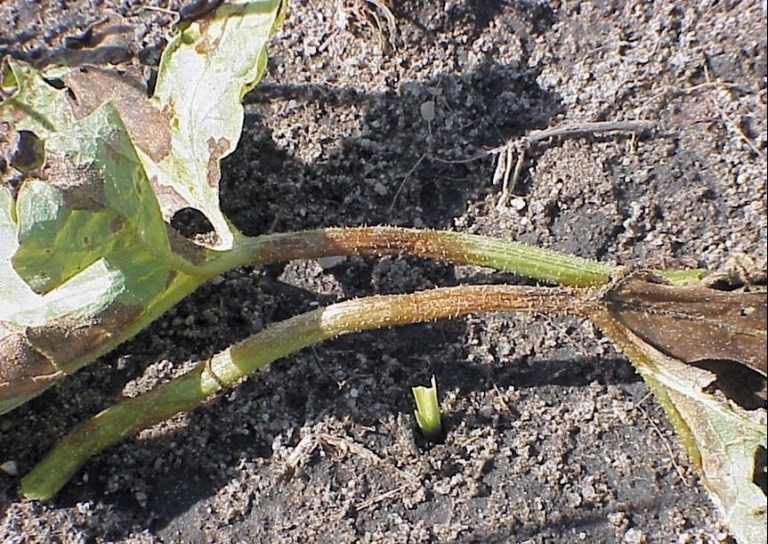
Symptoms
Water-soaked, then tan-to-grey lesions form on stems near the base or at leaf joints and ooze an amber-brown gum; leaves show V-shaped brown lesions starting from the margin, dotted with tiny black fruiting bodies; fruit develops a sunken black rot in storage. The gummy ooze plus pinhead black dots is the diagnostic clue.
Plants affected
Easily confused with
- cucurbit downy mildew
How to tell them apart: Didymella bryoniae (gummy stem blight) shows tan-to-brown roundish leaf spots, often beginning at the leaf margin and frequently dotted with tiny black pycnidia; the key sign is on the STEM, where dark cankers ooze a reddish-brown to amber gum. Pseudoperonospora cubensis (cucurbit downy mildew) produces ANGULAR yellow patches sharply bounded by the leaf veins on the upper surface, with a grayish-purple downy fuzz on the underside in humid mornings. To tell them apart: flip the leaf — downy mildew has under-leaf sporulation and vein-limited angular lesions, while gummy stem blight has rounded margin spots, black pycnidia dots, and the diagnostic gummy stem ooze.
- sclerotinia stem rot
How to tell them apart: Didymella bryoniae (gummy stem blight) shows tan-to-brown lesions on stems, leaves and crown, with a hallmark amber-to-reddish-brown gummy ooze seeping from cracked stem cankers; look closely for tiny black pinpoint dots (pycnidia) embedded in the dead tissue, and brown V-shaped lesions advancing inward from leaf margins. Sclerotinia sclerotiorum (white mold) produces a soft, watery rot covered by dense white cottony mycelium that looks like cotton wool on the stem base, fruit or crown; the decisive sign is the formation of hard, irregular black resting bodies (sclerotia) the size of rat droppings, found on or inside the rotted, hollowed stem. The amber gum plus black specks point to Didymella, while fluffy white cotton plus hard black lumps point to Sclerotinia.
Treatment
Dr. Phyto builds a dated, step-by-step treatment plan with country-approved products — start a free diagnosis to get yours.
Common questions
- How do I recognise gummy stem blight / black rot (cucurbits) on melon?
- Water-soaked, then tan-to-grey lesions form on stems near the base or at leaf joints and ooze an amber-brown gum; leaves show V-shaped brown lesions starting from the margin, dotted with tiny black fruiting bodies; fruit develops a sunken black rot in storage. The gummy ooze plus pinhead black dots is the diagnostic clue.
- Do I have to report gummy stem blight / black rot (cucurbits)?
- No. gummy stem blight / black rot (cucurbits) is not a notifiable organism, so there is nothing to report to an authority. Treat it as a normal garden problem.
- How is gummy stem blight / black rot (cucurbits) treated?
- Mainly with biological and cultural measures — removing affected material, changing the conditions that favour it, and treating with agents approved in your country. The exact steps and their timing depend on the plant, the season and where you live: Dr. Phyto works them out in a free diagnosis.
Free first diagnosis · no sign-up to start