Dr. Phyto
Asian longhorned beetle
Anoplophora glabripennis
⚠ EU-notifiable quarantine organism
Symptoms
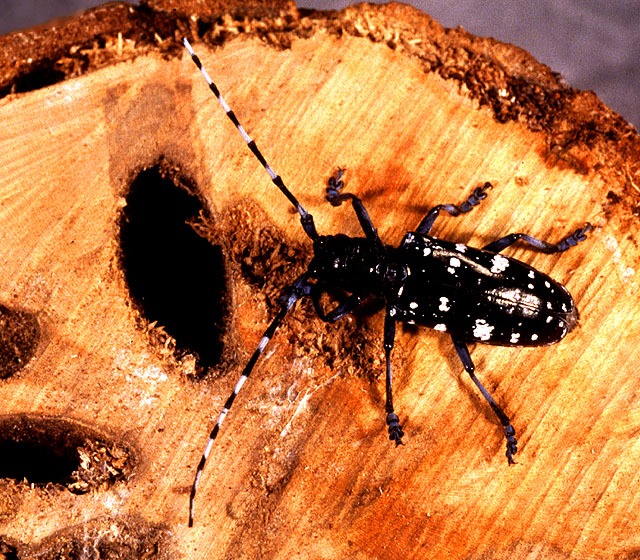
Adult beetles (2.5-3.5cm, black with white spots + long banded antennae) on trunks in summer, large round exit holes (1cm) higher up trunks (not just base — distinguishes from A. chinensis), sap flow + bark damage where larvae enter, sawdust on bark + ground, infested trees killed within 3-5 years.
Plants affected
Easily confused with
- bronze birch borer
How to tell them apart: Anoplophora glabripennis (Asian longhorned beetle) is a large longhorn beetle, 20-35 mm, glossy jet-black with irregular white spots and very long black-and-white banded antennae often longer than the body; its larvae bore deep into heartwood, leaving LARGE perfectly ROUND exit holes about 10-15 mm wide (pencil-sized), often low on the trunk and main branches, with coarse sawdust (frass) piling at the base. Agrilus anxius (bronze birch borer) is a small, slender metallic bronze/olive jewel beetle only 6-11 mm long; its larvae make winding serpentine galleries just under the bark, producing characteristic small D-SHAPED exit holes about 3-5 mm wide, with the first dieback starting at the TOP of the crown and progressing downward, and raised brown ridges/swellings (callus) over the larval tunnels on smooth birch bark. Look at the exit-hole shape first: round and large = Anoplophora; D-shaped and small = Agrilus. Both are EU-quarantine notifiable pests on birch — if you suspect EITHER, photograph the beetle, exit holes and frass and report it to your national plant protection organisation (NPPO) immediately; do not move infested wood.
- sooty bark disease of sycamore
How to tell them apart: On sycamore (Acer pseudoplatanus) both Anoplophora glabripennis (Asian longhorned beetle) and Cryptostroma corticale (sooty bark disease) cause slow crown dieback, but the signs on the trunk are completely different. Anoplophora glabripennis leaves perfectly round 6-10 mm exit holes bored into intact bark high on the trunk and large branches, with coarse pale wood-shaving frass piled in branch crotches and at the base, and shallow oval bark scars where females chewed egg niches. Cryptostroma corticale instead splits and lifts the bark in long vertical strips to expose dense, dry, soot-black to chocolate-brown powdery spore masses underneath the dead bark, often with a green-brown stain in the wood and no holes or sawdust. If you see round holes plus sawdust, suspect the quarantine beetle and report it to your national plant protection organisation (NPPO); black powdery dust under peeling bark points to the non-notifiable fungus.
- citrus longhorned beetle
How to tell them apart: Both Anoplophora chinensis (citrus longhorned beetle) and Anoplophora glabripennis (Asian longhorned beetle) bore the same ~1 cm perfectly round exit holes in sycamore maple, push out coarse pale sawdust/frass and cause branch dieback and crown thinning, so a photo of a hole and frass alone cannot separate them. The most reliable visible cue is hole HEIGHT: A. chinensis exit holes and frass piles cluster at the trunk base and exposed root collar, often at or below soil level, whereas A. glabripennis holes are scattered higher up the trunk and out along the main branches. On the adult, A. glabripennis is glossy jet-black with sharply defined white spots and antennae ringed black-and-white (whitish-blue bands); A. chinensis is duller black, its wing-case base roughened with small grain-like black tubercles you can see near the shoulders, with less crisp banding. Both are EU quarantine pests under Regulation 2019/2072 — do not treat or fell the tree; photograph it, leave it in place, and report the find immediately to your national plant protection organisation (NPPO).
Treatment
Dr. Phyto builds a dated, step-by-step treatment plan with country-approved products — start a free diagnosis to get yours.
Common questions
- How do I recognise Asian longhorned beetle on silver birch?
- Adult beetles (2.5-3.5cm, black with white spots + long banded antennae) on trunks in summer, large round exit holes (1cm) higher up trunks (not just base — distinguishes from A. chinensis), sap flow + bark damage where larvae enter, sawdust on bark + ground, infested trees killed within 3-5 years.
- Do I have to report Asian longhorned beetle?
- Yes. Asian longhorned beetle is a regulated quarantine organism in the EU. A suspected finding must be reported to your national plant protection organisation — they will confirm it and tell you what to do next.
- How is Asian longhorned beetle treated?
- Mainly with biological and cultural measures — removing affected material, changing the conditions that favour it, and treating with agents approved in your country. The exact steps and their timing depend on the plant, the season and where you live: Dr. Phyto works them out in a free diagnosis.
Free first diagnosis · no sign-up to start