Dr. Phyto
Honeysuckle powdery mildew
Erysiphe lonicerae
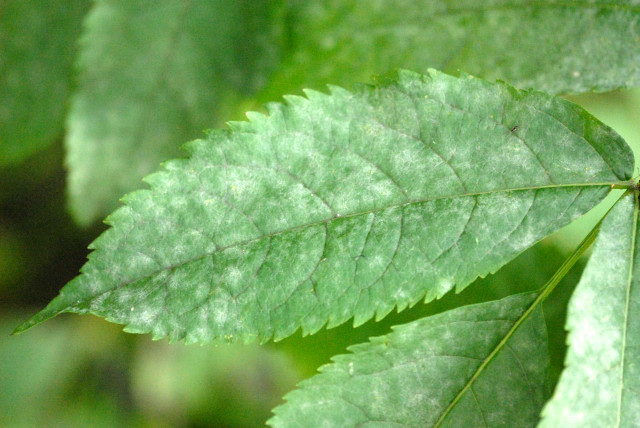
Symptoms
A fine, white-to-greyish powdery coating develops on the upper surfaces of leaves and on young shoots, looking as if the foliage has been dusted with flour. The mealy growth can be rubbed off with a finger, leaving the leaf surface beneath intact at first; heavily colonised leaves later turn yellow, curl, dry out brown and drop early. On strongly affected plants the coating also spreads to flower buds and stems, stunting new growth and dulling the flowering display. Late in the season tiny black dot-like fruiting bodies (chasmothecia) may speckle the white mat.
Plants affected
Easily confused with
- grey mould (Botrytis)
How to tell them apart: Both fungi grow as a 'mould' on honeysuckle leaves and flowers, but Erysiphe lonicerae (powdery mildew) is a dry, white-to-grey superficial powder, mainly on the UPPER side of otherwise firm green leaves, that wipes off with a finger and leaves the tissue beneath alive. Botrytis cinerea (grey mould) is a fuzzy grey-brown sporulating felt that grows ON dead, water-soaked, rotting tissue — collapsing flowers, buds and soft shoots — and is associated with brown rot and slime, not a dusting on healthy leaves. Powdery mildew loves warm dry days with humid nights; grey mould loves cool, wet, stagnant conditions and dead plant material.
Treatment
Dr. Phyto builds a dated, step-by-step treatment plan with country-approved products — start a free diagnosis to get yours.
Common questions
- How do I recognise Honeysuckle powdery mildew on honeysuckle (woodbine)?
- A fine, white-to-greyish powdery coating develops on the upper surfaces of leaves and on young shoots, looking as if the foliage has been dusted with flour. The mealy growth can be rubbed off with a finger, leaving the leaf surface beneath intact at first; heavily colonised leaves later turn yellow, curl, dry out brown and drop early.
- Do I have to report Honeysuckle powdery mildew?
- No. Honeysuckle powdery mildew is not a notifiable organism, so there is nothing to report to an authority. Treat it as a normal garden problem.
- How is Honeysuckle powdery mildew treated?
- Mainly with biological and cultural measures — removing affected material, changing the conditions that favour it, and treating with agents approved in your country. The exact steps and their timing depend on the plant, the season and where you live: Dr. Phyto works them out in a free diagnosis.
Free first diagnosis · no sign-up to start